conversion of metric to Imperial (meters to feet and inches) lengths
conversion of VSWR losses to dB losses
conversion of impedance values to VSWR, return loss and mismatch loss
conversion of reactance value to inductance or capacitance value
addition or subtraction of two decibel (dB) values
quarter-wave line matching transformer
Frequency / wavelength calculator
Speed of light:
m/s
Frequency:
Wavelength:
Metric to Imperial units calculator
Convert decimal meters to feet and inches, or
Convert decimal feet to meters
Simply type a meters or feet length into the appropriate field, and the corresponding value will be calculated as you type:
Meters:
m
Feet:
ft
=
Convert VSWR value to power loss
Any value of VSWR higher than 1:1 can cause power loss due to reflected RF being dissipated
in the feeder line. Use this to calculate how much power loss is due to VSWR:
Power input:
W
VSWR value:
: 1
Mismatch loss:
dB
Percentage loss;
%
Reflection coefficient:
Percentage output:
%
Power output:
W
Convert impedance values to VSWR, return loss and mismatch loss
Choose a system or coax cable impedance, input a complex load impedance, and calculate the following:
Reflection coefficient
VSWR
Return loss
Mismatch loss
System impedance:
Ω
Load impedance:
Resistive:
Ω
Reactive:
Ω
Reflection coeff.:
VSWR:
: 1
Return loss:
dB
Mismatch loss:
dB
Convert reactance value to inductance or capacitance value
Frequency:
MHz
Reactance:
j (Ω)
Inductance:
µH
Capacitance:
pF
Decibel calculator
Add or subtract two decibel (dB) values
Decibel value #1:
dB
Decibel value #2:
dB
Result:
dB
Quarter-wave line matching transformer
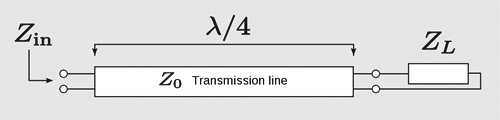
The 1/4-wave line matching transformer, also known as a Q-section, is a section of feed-line
having a specific impedance designed to transform an input impedance to a different output
impedance.
This can be useful when connecting feedlines of different impedances: say, a length of 50Ω coaxial
line to a length of 75Ω coaxial line.
The matching 1/4-wave section is connected in series between the input line and the output line, or load.
First impedance, Zin
Ω
Second impedance, ZL
Ω
Matching impedance, Z0
Ω
Shortening coil calculator for 1/4-wave verticals
Building a 1/4-wave vertical antenna for the low HF bands can be problematic, since the full length required can be difficult or
impossible for many to manage, especially when operating portable. Fortunately, there exist a few methods by which the
physical length of the radiator can be shortened, while still maintaining the desired frequency. Here are two such methods:
use inductive base loading, or
use capacitive top loading
to electrically lengthen a much-shortened radiator. In the following calculations, we use inductive base loading; capacitive
top loading, using a so-called "capacitive hat" is beyond the scope of this site.
Part #1 - Calculate coil inductance
We first calculate the inductance required to shorten our vertical antenna, given the frequency, antenna wire length, position of
the coil and the antenna wire diameter. To do this, we use the classic formula, originally published by J. Hall, "Off-center
loaded dipole antennas", QST Sept 1974, pp28-34, and re-printed in the ARRL Antenna Handbook, 20th edition, p6-31:
LµH = calculated coil inductance in micro-Henrys,
f = frequency in MHz,
A = total vertical length,
B = vertical length from the feedpoint to the center of the loading coil,
D = diameter of the antenna wire.
The formula as it stands required lengths to be in feet and inches, but this calculator requires you to enter lengths in metric
units only:
Frequency:
MHz
Coil inductance:
µH
1/4 wavelength (REF.):
m
New antenna length:
m
Coil center-height:
m
Antenna wire diameter:
mm
Part #2 - Calculate coil dimensions
We'll now use the inductance LµH, which we have derived using the above calculator, to estimate
the parameters of a coil which we can use to electrically lengthen a short vertical antenna for use in the lower HF bands.
Highly accurate estimates of such parameters can be made, but these involve very complex mathematical expressions
(1), which are beyond the scope of this site. Instead, we make use of much simpler expressions/formulas which will give results
accurate to within 1 or 2 percent - easily good enough for the practical purposes of constructing an antenna for portable use.
We use the well-known formulas from H. A. Wheeler
(2)
for single- and multiple-layer air-cored helical coils. These formulas were derived empirically by Wheeler from inductance
formulas and curves from the US Bureau of Standards, and published in October 1928. It's recommended to use "enamelled"
magnet wire for the coil windings, since this type of wire has a very thin but flexible insulation coating, allowing the
coil windings to be as close-spaced as possible.
Coil former:
The relative DC permeabilities μr of plastics commonly used as coil formers are very
close to unity (as for air). However, at RF frequencies, some plastics can be lossy, especially PVC. The best core is
no core - an "air-core" coil is the least lossy core type.
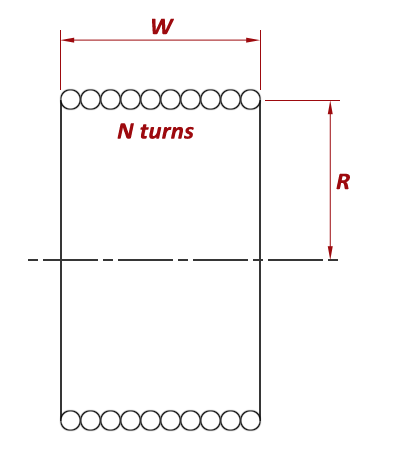
Single-layer helical coil
The first formula used here is for a single-layer air-cored helical coil:
\[
L_{\mu H} =
\frac{N^2 R^2}{9R + 10W}
\]
where
LµH = coil inductance in micro-Henrys,
N = number of turns of wire,
R = coil mean radius in inches,
W = coil width in inches.
This formula is claimed to be accurate to within 1 percent for coils having W > 0.8R.
Fig.1 - Single-layer coil
Coil inductance:
µH
No. of turns:
Coil width:
mm
Coil wire len.:
m
RF resistance:
Ω
Coil mean radius:
mm
Coil wire diameter:
mm
Windings spacing:
Est. coil Q-factor:
If you intend to use enamelled wire in your coil (acceptable for the higher HF bands or VHF), you can take a coil wire diameter value
from this dropdown list of standard enamelled wire sizes:
Enamelled wire sizes:
(Some wire sizes may not be readily available from your suppliers)
Part #3 - A note on radials lengths for shortened verticals
Once you have decided on the length of your shortened radiator section, you need to consider the lengths of the radials you
will be using with your antenna. Basically speaking, since radials act more like a loss-reduction system than tuned elements,
any length of radials is better than no radials at all, and so shortened radials
can be used with your coil-loaded short vertical antenna, but there will be a trade-off:
shorter radials = easier to handle,
but reduced antenna efficiency.
Shortening the vertical with a loading coil mainly fixes reactance (resonance), but it does not reduce the current that must
flow in the "ground system". Radials form the return path, or image plane, for current returning to your feed system,
so shortening the radials will both:
increase signal loss, and
decrease the bandwidth of your antenna,
Keep this in mind when choosing a length for your radials: 0.25 λ is the optimum choice in terms of efficiency, but
if space is at a premium, you may decide to use more radials, each perhaps a little shorter than the 0.25 λ optimum length.
There is no special radial-lengths rule to be applied here: ultimately, you make a choice, build your antenna, and test it.
Calculates an LC L-network to match a source impedance \(R_{\text{source}}\) to a load impedance
\(R_{\text{load}} + jX_{\text{load}}\) at a single frequency.
An LC L-network provides an exact match at the design frequency, typically with limited bandwidth, whereas broadband
transformers (ununs, baluns) provide a more general but less precise match.
Key article takeaways » » »
Matches impedance at one frequency only
Two valid solutions usually exist
Low impedance → low L-match Q → wide bandwidth
High impedance → high L-match Q → narrow bandwidth
Component losses may reduce efficiency
Two solutions are usually possible for each L-match calculation:
a low-pass network (series L, shunt C);
a high-pass network (series C, shunt L).
When two solutions are possible (as is most often the case), then both solutions give the same match, but with different voltage
and current stresses. For high-impedance loads, the low-pass solution is often preferred, since inductors suffer increasing
resistive loss as current rises, whereas capacitors can tolerate high voltage with relatively low loss. In addition, the
low-pass solution provides a DC path to ground, which helps bleed off static charge. The high-pass solution may be chosen
where DC blocking is required.
Inductors in L-match networks may be air-cored or wound on toroidal cores. Air-core inductors offer the lowest loss and are
often preferred for single-band matching, while toroidal inductors (especially those using powdered-iron cores) provide a more
compact and convenient solution for low-power portable or multi-band use.
The solutions presented here are most suitable for use in the following configurations:
Typical ranges of impedances Z for these antennas:
Antenna type
Typical resistive impedance Rload
EFHW
2–5 kΩ
End-fed vertical (e.g. 1/2-wave vertical)
1–4 kΩ
Near-end-fed dipole (e.g. OCFD)
0.5–2 kΩ
Random wire
0.1–5 kΩ
L-match calculator
Frequency:
MHz
System impedance:
Ω
Load impedance:
Resistive:
Ω
Reactive:
Ω
Coil quality (Qcoil):
Typical air-core coil
No solutions found for this configuration!
Solutions:
Low-pass solution
Series L:
µH
Shunt C:
pF
L-match Q:
Efficiency:
%
Notes:
• High voltage on capacitor • Passes DC
Low pass L match
High-pass solution
Series C:
pF
Shunt L:
µH
L-match Q:
Efficiency:
%
Notes:
• High current in inductor • Blocks DC
High pass L match
(Efficiency estimates use chosen coil Q. Capacitor losses are ignored.)
Reference
Table of L-match circuit Q values, listing applicable ranges and usages.
L-match Q
Equivalent transformation ratio (approx.)
L-match bandwidth
Tuning sensitivity
Component stress
Typical use case
< 1
1 - 2
Very wide
Very forgiving
Very low
Near-50 Ω antennas
1 - 2
2 - 5
Wide
Easy
Low
Mild matching
2 - 3
5 - 10
Moderate
Noticeable
Moderate
Typical practical matching range
3 - 5
10 - 25
Narrowing
Sensitive
Higher
End-fed / OCFD
5 - 8
25 - 60
Narrow
Quite sensitive
High
EFHW typical
8 - 12
60 - 100
Very narrow
Very sensitive
Very high
Extreme ratios
> 12
> 100
Extremely narrow
Critical
Severe
Usually impractical
Higher Q increases voltage across capacitors and current through inductors.
Wire cutting/adjustment table
When creating a new wire antenna, it is always advisable to
add extra length
- a couple of percent extra - to the calculated length. In this way, you ensure that the wire you cut for the antenna is, from the
outset, not too short for its' intended purpose.
It's handy to know just how much wire to cut off, in order to arrive at the correct length - i.e. the length at which the antenna
resonates at the intended frequency, or frequencies. The table presented here can help you to determine just that. Values in the
table are based on a quarter-wave length of wire: thus, when adjusting a dipole for instance, the amount to be cut will be removed
from each quarter-wavelength section, that is to say from each "arm" of the dipole.
Use the controls to choose your wire core diameter, and insulation thickness and type if needed: the table will be updated to reflect
your choice.
Wire core:
mm diameter
Wire insulation:
thickness
Insulation type:
Insulation correction factor:
Band
Reference frequency (kHz)
Adjustment in millimeters for discrepancy in frequency at VSWR minimum
10 kHz
25 kHz
50 kHz
75 kHz
100 kHz
150 kHz
200 kHz
250 kHz
300 kHz
350 kHz
400 kHz
500 kHz
160 meters
1860
80 meters
3650
60 meters
5350
40 meters
7100
30 meters
10135
20 meters
14175
17 meters
18120
15 meters
21225
12 meters
24940
10 meters
28500
6 meters
51000
To use the values listed, it will be necessary to first erect the antenna in its' intended configuration. Attach a length of coax,
and measure the VSWR on the band of interest with whatever you have available - an analog VSWR meter, or a VNA / digital VSWR device.
Note the frequency at the VSWR minimum, and estimate how far this deviates from the desired operating frequency: this deviation we will call
delta.
Find, in the table headers, the closest frequency discrepancy to this delta (you may wish to interpolate between two columns) and, in the
row for the band of interest, read off the required adjustment in millimeters. Given your choice of wire and insulation, this
adjustment amount should be close to what you will need to cut from the wire, in order that the VSWR minimum frequency will be close to
the desired operating frequency. Make your adjustment to the antenna, and measure the VSWR again.
Example: Suppose we are adjusting the length of a new flat-top dipole for
the 20-meter band, and for a desired frequency of 14200 kHz. The dipole is constructed of wire 1.5 mm diameter, with 0.6 mm thick PTFE
insulation, and we elect to include end-effect in the calculations. We erect the dipole at the design height, and measure its'
VSWR over a sweep covering the entire band.
Let us now suppose that the actual VSWR minimum occurs at 13920 kHz, or 280 kHz lower than required. From the table, and interpolating
between values in adjacent columns, we estimate the amount to be cut, delta, to be approximately 102 mm.
Since this is a symmetrical dipole, this amount would need to be cut from
both ends
of the antenna.
Exercise caution here, however - see the note below.
Please note that the values listed in the table are intended only as an
approximate guide to adjusting the length of your antenna - as with all things, caution is advised when cutting antenna wire to
length.
If in doubt, take less off than the value derived from the table, and
measure the VSWR again.
Cut back, or fold back?
Assuming that the antenna wire starts out being too long, we need to shorten its length. We could do this in one of two different ways:
Fold back a section of wire to test the effect before cutting permanently
Folding back wire usually shortens the antenna electrically while allowing easy adjustment and reversal. However, the folded
section may slightly interact with the main wire, so the final resonant frequency can differ slightly from that obtained after
permanently cutting the wire.
Cut the excess wire permanently
Removing wire completely gives the final electrical length and generally produces the cleanest and most predictable behaviour.
However, once cut, the process cannot easily be reversed, so adjustments should be made gradually and cautiously.
Table values calculation
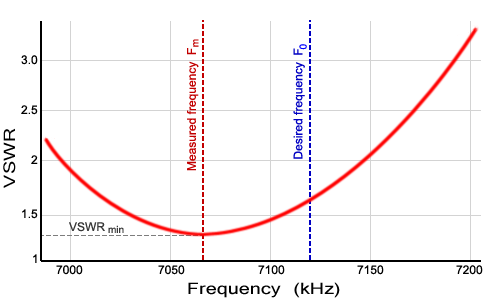
Since we cut the wire section long, the first VSWR measurement will (hopefully!) be at a lower frequency than that desired.
Let the measured frequency of minimum VSWR be \(f_{m}\), the desired resonant frequency be \(f_{0}\), and the measured radiator
length be \(L_{m}\) :
Then, the antenna section length for resonance at the desired frequency
\[ L_{0} = \frac{ f_{m} L_{m} }{f_{0}} \]
Hence, the wire must be shortened by an amount
\[ d_{L} = L_{m} - L_{0} \]
Another way of looking at this is as follows: for one side of a dipole, the difference in length between two pieces of wire
cut for different frequencies \(f_{1}\) and \(f_{2}\) is given by:
\[
d_{L} = k c \!\left(
\frac{f_{2} - f_{1}}{4 \, f_{1} f_{2}}
\right)
\]
for a quarter-wavelength, where
\(k\) = length-correction factor for the wire (depends on various parameters including end-effect and insulation type/thickness)
\(c\) = speed of light
End-fed random wire antenna lengths calculations
End-fed random-length (EFRL) wires can be very effective multi-band antennas, but finding the right length for your own situation can
be difficult. Suitable lengths must conform to these criteria:
the antenna must be non-resonant on any of the bands you want the antenna to cover;
the length must be at least a 1/4 wavelength on the lowest frequency band you wish to use, and does not
need to be longer than 1/2 wavelength on that band, although you may use a longer one if you wish;
the antenna impedance should be moderate - in the hundreds of ohms - on all bands you wish to use.
Note that this does not imply a low VSWR!
End-fed random-length antennas often exhibit VSWR values
of several-to-one and normally require an antenna tuner.
There are many sources online which claim to have the length you need, or which present lists of lengths to try, and choosing between
them can be challenging (see "Proposed lengths" section below).
Use this tool to chart lengths applicable to your own EFRL antenna setup: you will set dimensions and type of both wire and insulation,
a choice of bands to be covered by your antenna, and a suitable length representing your garden/yard/field where the antenna is to be
erected.
Click the "Chart results" button to start the process: the program will
identify the lengths to be avoided, and will show these in colored regions in the chart, the colors corresponding to frequency bands
and their harmonics. These colored areas mark lengths for the chosen bands at multiples of 1/2 wavelength, and
hence lengths presenting feed-point high impedances leading to high voltages in matching devices.
Any clear, non-colored, areas in the chart will mark lengths, or ranges of lengths, from which you can choose a length for
your own use.
Also charted will be one or more of the "proposed" lengths listed in the table below. Lengths may be read directly from
the tooltip shown when the mouse hovers over the chart.
Wire core:
mm diameter
Wire insulation:
thickness
Insulation type:
Choose bands:
No. of ½-waves:
Limit results to:
meters in length, maximum
Zoom in:
Click and drag horizontally
Zoom out:
When zoomed in, use the "Reset zoom" button, upper right
Panning:
When zoomed in, hold down the Shift key, click and drag horizontally
"Proposed" lengths
A few optimal lengths, or length-ranges, have been worked out by several operators, see e.g.
The "Best" Random Wire Antenna Lengths...
some are listed here as a helpful guide (the length most often quoted online is probably the 71ft / 21.64m variant).
The values in the table will be plotted as dashed "proposed" length-lines in the chart:
Length, feet
Length, meters
Bands*
29.0
8.84
30m - 10m
35.5
10.82
40m - 10m
41.0
12.50
40m - 10m
52.0
15.85
60m - 10m
58.0
17.68
60m - 10m
71.0
21.64
80m - 10m
107.0
32.61
80m - 10m
119.0
36.27
80m - 10m
135.0
41.15
160m - 10m
148.0
45.11
160m - 10m
203.0
61.87
160m - 10m
347.0
105.77
160m - 10m
407.0
124.05
160m - 10m
423.0
128.93
160m - 10m
*Some bands may not be available or tunable in your setup
 Web Hosting by Digital Ocean